
Donate a Water Hand Pump in Pakistan: An Honest Guide to the Best Sadaqah Jariyah
7 August 2026
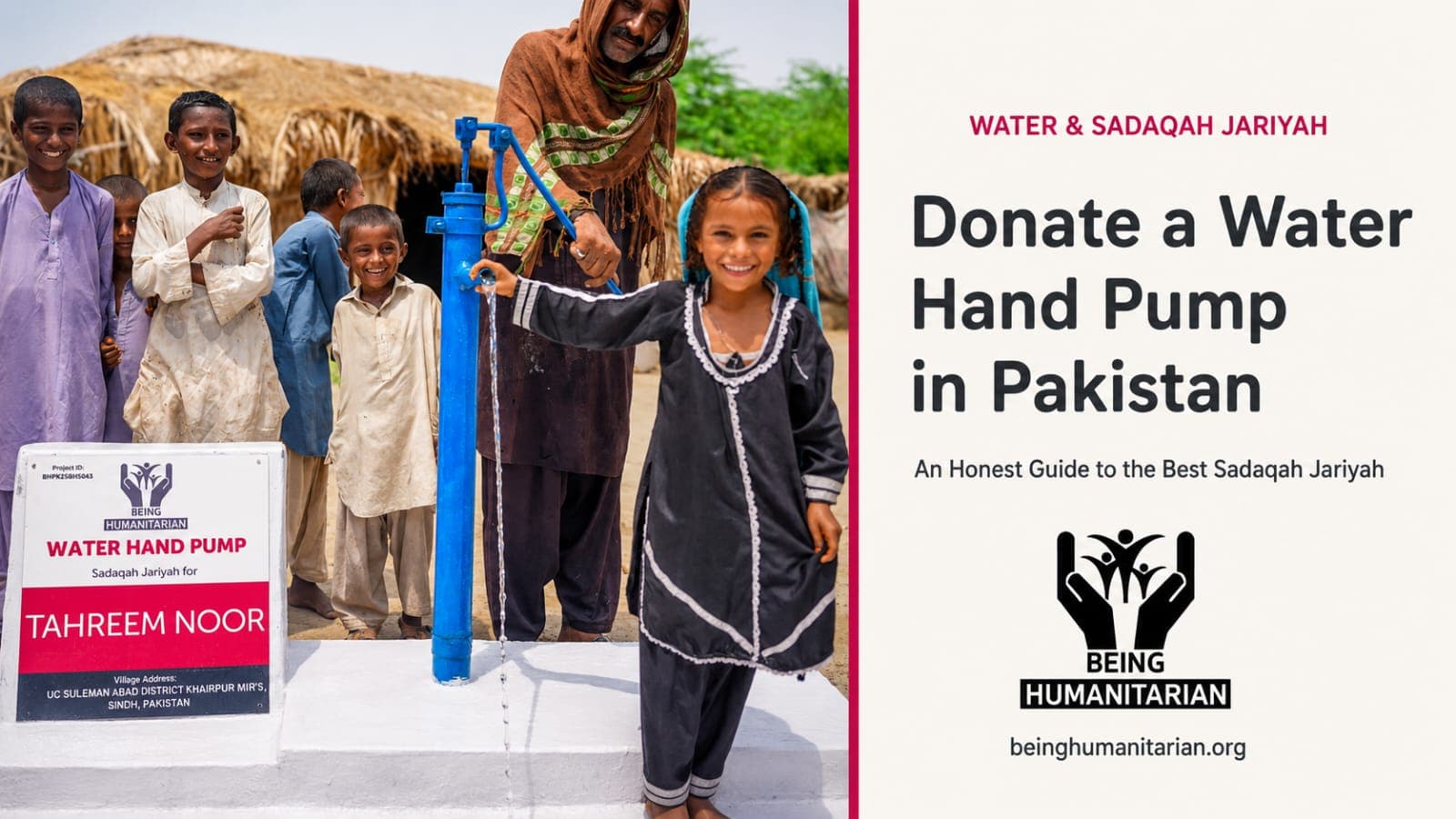
Donate a Water Hand Pump in Pakistan: An Honest Guide to the Best Sadaqah Jariyah
When Sa'd ibn Ubadah's mother died, he asked the Prophet Muhammad, peace be upon him, which charity would be best for her. The answer was water. Sa'd dug a well and dedicated it to her. Fourteen centuries later, that is still the model. For £85 you can donate a water hand pump in Pakistan and place that same act in the ground, in your name or in the name of someone you have lost.
This guide is written differently from most water appeal pages. It gives you the real serving numbers rather than inflated ones, the real timeline rather than an optimistic one, and the real reasons a pump sometimes fails. We believe an act of worship deserves accurate information, not marketing.
Why Water Is the Best Charity in Islam
Allah says in the Qur'an: "And We made from water every living thing" (Surah Al-Anbiya 21:30). Water is not simply a resource in Islam. It is the substance through which Allah gives life, and the means by which a Muslim purifies themselves for prayer five times a day.
Sa'd ibn Ubadah, may Allah be pleased with him, reported that he asked the Messenger of Allah, peace be upon him, whether he could give charity on behalf of his deceased mother. The Prophet said yes. Sa'd then asked which charity was best. The Prophet answered: a drink of water. (Sunan al-Nasa'i 3664, graded hasan by al-Albani.) Sa'd dug a well and dedicated it to his mother.
There is a scholarly point worth knowing here, because we would rather you gave with knowledge than with a slogan. Some scholars noted a break in the chain of narration for this hadith. Al-Albani graded it hasan, and Ibn al-Qayyim explained the underlying principle in a way that removes any doubt about the meaning: the best charity is the one that meets the recipient's actual need and continues over time. Water given where there is drought and thirst is therefore among the greatest of charities, because there the need is greatest.
That principle is the entire reason we install in Tharparkar and Rajanpur rather than in easier places.
The second hadith every donor should know is in Sahih Muslim 1631. The Prophet, peace be upon him, said that when a person dies their deeds end except for three: ongoing charity, beneficial knowledge, and a righteous child who prays for them. A hand pump is the first of those three, set in concrete, drawing water every day.
Water and Worship
There is a dimension of a hand pump that a purely humanitarian report will never capture. Every day, in the households where we install, that pump supplies the water for wudu before Fajr, Zuhr, Asr, Maghrib and Isha. It supplies the water for ghusl. It supplies the water a mother uses to wash her children before Jummah.
A family that previously performed wudu with pond water, or rationed it because of the distance carried, now performs it with clean water at their door. By the mercy of Allah, the reward of every one of those prayers is connected to the person who funded the pump.
The Water Crisis in Pakistan
The Islamic case for water is timeless. The Pakistani case is urgent and specific.
Experts at the Pakistan Institute of Development Economics reported in 2025 that only 47 percent of Pakistanis have access to safe drinking water. The Pakistan Council of Research in Water Resources recorded per capita freshwater availability falling below 1,000 cubic metres in 2024, down from 5,260 cubic metres in 1951. Below 1,000 cubic metres a country is formally classified as water scarce.
UNICEF Pakistan estimates that around 70 percent of households drink water contaminated with bacteria. Researchers attribute between 30 and 40 percent of Pakistan's total disease burden to unsafe water, including diarrhoea, hepatitis and typhoid.
Around 28 percent of Pakistani households already use a hand pump as their main drinking water source, according to the Pakistan Social and Living Standards Measurement Survey. This is worth pausing on. The hand pump is not a foreign solution being introduced. It is already the everyday water technology of rural Pakistan. Our work is to place a properly sited, properly bored and properly maintained one where a family currently has nothing.
What the Alternative Looks Like
In the villages where we work, families without a pump rely on one of three things. An open pond shared with livestock. A shallow hand dug well that fills with surface runoff. Or a walk of two to four kilometres, made two or three times a day, almost always by women and girls.
Each carries a compounding cost. A child with recurring diarrhoea cannot absorb nutrients, which is why waterborne illness and stunting travel together. A woman spending hours fetching water cannot earn or supervise schooling. A family paying for typhoid treatment at a private clinic can lose a month's income to a single illness.
What Is a Water Hand Pump and How Does It Work?
A water hand pump is a manually operated device that lifts groundwater to the surface through a bored hole, using no electricity, fuel or motor.
A complete installation includes a bored hole reaching a safe water bearing layer, a column of galvanised pipe, a cylinder and piston assembly, a lever handle, and a concrete platform with a drainage channel at the surface.
That concrete platform is a public health intervention, not decoration. Without a sealed apron and a soakaway, spilled water pools at the pump head, breeds mosquitoes, and can carry surface contamination back down the bore. A pump installed without one will be making people ill within two years.
How Deep Does the Bore Need to Be?
This is the question that separates a working pump from expensive scrap, and almost no charity website answers it.
Depth depends entirely on local hydrogeology. In parts of Sindh a safe aquifer sits at 60 to 80 feet. Elsewhere the shallow water table is brackish or arsenic affected and the bore must reach 150 feet or more to find water fit to drink. In some Tharparkar settlements the water table sits below the practical reach of any manual pump, which is why we assess before we promise.
Arsenic and salinity are the two issues a responsible implementer in Pakistan cannot ignore. Large stretches of the Indus plain in Sindh and southern Punjab carry naturally occurring arsenic in shallow groundwater. A pump can produce clear, cold, pleasant tasting water and still be delivering a slow poison. This is why water quality testing happens before a site is signed off, not after.
What Does It Cost to Donate a Water Hand Pump in Pakistan?
A Being Humanitarian water hand pump costs £85, with zero administration cost deducted from your donation.
UK charities price comparable hand pump installations anywhere from £75 to £290. Our £85 sits near the lower end of that range. That is structural, not a matter of cutting corners. Being Humanitarian runs its own country office in Pakistan rather than routing funds through layers of intermediary partners, and our administrative costs are met separately so that nothing is taken from your gift.
It is worth being candid in the other direction too. A hand pump advertised far below this range usually means a shallower bore, and in Sindh and southern Punjab a shallow bore is precisely where contamination begins. £85 buys the depth, the water testing and the concrete platform that decide whether the pump is still safe to drink from in year five.
Where Your £85 Goes
Component | Approximate share |
|---|---|
Boring and drilling labour | 35% |
Pipe, cylinder, piston and pump head | 30% |
Concrete platform, apron and drainage | 15% |
Site assessment and water quality testing | 8% |
Transport and logistics to remote sites | 7% |
Verification, GPS capture, photography and reporting | 5% |
What You Receive
Photographs of the completed pump and the family using it
A dedication plaque in your name or the name of a loved one
GPS coordinates of the exact installation point
A written completion report from our field team in Pakistan
We provide GPS coordinates because the most reasonable question a donor can ask is whether the pump was ever actually built. Coordinates you can drop into a map on your own phone are a better answer than any promise we could write.
Realistic Impact: What One Hand Pump Actually Does
Here is where this page departs from the sector.
You will see charities claim that a single hand pump serves 250 to 300 people. Some claim four to six families. We do not believe those figures describe a household hand pump honestly, and inflated numbers are not a small thing when a person is giving in the name of their late mother.
A single hand pump in the communities where we work typically serves one household directly and one or two neighbouring households informally. That is realistically 8 to 20 people using it daily.
In a dense settlement it can be more. In scattered desert hamlets it is often just one family. We report what our field team records, not an average borrowed from someone else's brochure.
We would also rather you knew this: 8 to 20 people is not a small outcome. A pump used forty times a day for eight years is well over one hundred thousand individual acts of benefit. Every drink, every pot of rice, every wudu. That is what Sadaqah Jariyah actually looks like when you count it properly rather than inflate it.
Hand Pump, Deep Well or Solar System: Which Should You Fund?
Hand pump | Deep bore well | Solar powered system | |
|---|---|---|---|
Typical cost | £85 | £900 to £3,000 | £1,800 and above |
People served | 8 to 20 | 100 to 400 | Up to 1,000 |
Realistic lifespan | 5 to 10 years with maintenance | 15 to 25 years | Around 20 years |
Power | None, manual | Motorised, needs grid or generator | Solar, no running cost |
Time to complete | 8 to 16 weeks typically | Several months | Several months |
Best for | Individual families, scattered rural settlements, emergency response | Villages with a defined centre | Larger communities needing storage |
The honest guidance is this. If you want the most families reached per pound and the fastest completion, fund hand pumps. If you want one landmark project for a whole village, fund a well. If you are giving in memory of someone and want the longest duration of ongoing benefit, a solar system lasts longest.
For most donors giving between £85 and £600, hand pumps deliver more households reached with less risk of a single point of failure. Ten pumps across ten hamlets is more resilient than one well that breaks.
Where Being Humanitarian Installs Water Hand Pumps
Tharparkar, Sindh. Pakistan's most water stressed district. Desert terrain, minimal rainfall, and the longest daily water walks we encounter anywhere.
Naushahero Feroze, Sindh. Our Water Project 2026 site in Village Bilal Colony, Taluka Mehrabpur, pairs hand pump installation with tree plantation so the water source and the local environment strengthen together.
Mehrabpur, Sindh. Dense rural settlement with severe shallow groundwater quality problems, where bore depth decides every installation.
Rajanpur, South Punjab. A flood exposed district where existing water points are repeatedly destroyed or contaminated by seasonal inundation.
Zakat, Sadaqah and Sadaqah Jariyah: Which Applies?
Sadaqah. Any voluntary donation towards a hand pump is valid Sadaqah.
Sadaqah Jariyah. A hand pump is one of the clearest examples of ongoing charity available. Benefit continues daily for the life of the pump, and by the mercy of Allah the reward continues after the donor's death.
Zakat. This deserves a straight answer, because charities differ. Some explicitly state their water appeals are not Zakat applicable. Others accept Zakat for water infrastructure.
Being Humanitarian accepts Zakat for hand pump installation where the recipient household falls within the categories defined in Surah At-Tawbah (9:60), primarily al-fuqara and al-masakin, the poor and the needy. The basis is that the asset transfers into the ownership and benefit of an eligible household rather than remaining a general public utility. Household eligibility is verified during field assessment before installation.
If you follow a scholarly position that requires stricter tamlik, or you are simply unsure, give from your Sadaqah instead. Your reward is not diminished, and we would rather you gave with a settled heart.
Surplus funds. If a specific site becomes unviable after assessment, your donation is redirected to the next scheduled hand pump installation rather than held.
Giving a Hand Pump in the Name of a Loved One
This is the oldest form of this charity, and for many of our donors it is the whole reason they give.
Sa'd ibn Ubadah did not dig his well as a general act of philanthropy. He dug it for his mother, after her death, on the direct instruction of the Prophet, peace be upon him, that water was the best charity he could give on her behalf.
If you have lost a parent, a spouse, a sibling or a child, a hand pump lets you do exactly what Sa'd did. The dedication plaque carries their name. The photographs and the completion report give your family something tangible to hold. Many of our donors repeat it annually on the anniversary, and some fund one pump per year for a parent across several years.
You can also dedicate a pump to a living person. It is an increasingly common gift for a wedding, an Aqiqah, a graduation or Eid, and it is a far more meaningful present than anything that can be wrapped.
When to Give: The Seasons of Water
Water can be given at any time, and the need does not observe a calendar. But certain moments carry particular weight, and the summer months are when Pakistan's water crisis is at its most severe.
Ramadan. Reward for voluntary acts is multiplied, and the connection between thirst and charity is felt directly by anyone fasting through a long day.
The first ten days of Dhul Hijjah. The most beloved days for righteous deeds, and a powerful window for funding an ongoing charity.
Muharram and Ashura. Increasingly chosen by donors for water specifically, both for the merit of the month and for the association with thirst in Islamic memory.
Summer, from May to August. This is the practical answer. Temperatures across Sindh and southern Punjab regularly exceed 45 degrees, shallow sources dry out, and daily water walks lengthen at exactly the moment they become most dangerous.
What Happens After You Donate
Allocation. Your donation is assigned to the next scheduled installation in an assessed community.
Field assessment. Household need, existing sources, distance travelled and Zakat eligibility are verified on site.
Water quality testing. Establishes required bore depth and screens for contamination.
Site approval. Documented photographically before work begins.
Installation. Carried out by vetted local contractors under Being Humanitarian field supervision.
Platform and drainage. Concrete apron completed and cured.
Handover. The receiving household is given basic maintenance training.
Documentation. GPS coordinates captured, photographs taken, plaque installed.
Your report. A written completion report is prepared and sent to you.
Realistic timeline: 8 to 16 weeks in normal conditions. It can extend to five or six months if the monsoon, flooding or extreme summer heat closes access to a site. Some charities quote six to nine months. Any charity promising a completed pump in days is describing a wish, not a process.
Why Hand Pumps Fail, and How We Prevent It
Across South Asia, a significant proportion of donor funded water points stand broken and abandoned within a few years of installation. This is the part of the sector nobody advertises, and you deserve to know it before you give.
A hand pump is a machine with moving parts, and moving parts wear. Leather washers in the cylinder degrade. Handle bearings loosen. Rising mains develop leaks at threaded joints. A pump producing water beautifully in month one can be derelict by month thirty if nobody in the village knows how to fix it or has the small amount of cash needed for a part. The installation gets funded. The afterlife does not.
Our approach is to make the receiving household the owner rather than the beneficiary. Handover includes practical instruction in identifying and replacing common wear parts. We deliberately specify pump models whose spares are sold in local markets rather than imported designs that cannot be repaired locally. Field officers revisit sites during subsequent programme cycles and record functionality.
We would rather install fewer pumps still working in year eight than more pumps that photograph well in week one. Sadaqah Jariyah means ongoing. A pump that stops is a charity that stopped.
Donate a Water Hand Pump in Pakistan Today
£85 places clean water at a family's door. It removes a four kilometre walk from a girl's day. It takes a child out of the cycle of waterborne illness. And it keeps giving, every day, for as long as the handle moves and by the will of Allah long after.
Donate a Water Hand Pump for £85 Photographs, GPS coordinates, a dedication plaque and a full completion report. Zero administration cost deducted from your gift.
Frequently Asked Questions
How much does it cost to donate a water hand pump in Pakistan? A water hand pump with Being Humanitarian costs £85, with no administration cost deducted from your donation. UK charities price comparable installations between £75 and £290.
How many people does one hand pump serve? Realistically 8 to 20 people. It typically serves one household directly and one or two neighbouring households informally. Figures of 250 or more people describe community wells, not household hand pumps.
Is a water hand pump Sadaqah Jariyah? Yes. Water is among the most explicitly encouraged forms of ongoing charity in Islam, and the reward continues for as long as people benefit, including after the donor's death, as described in Sahih Muslim 1631.
Can I give my Zakat for a water hand pump? Yes, where the recipient household falls within the categories in Surah At-Tawbah (9:60), primarily the poor and the needy. We verify eligibility at field assessment. If you follow a stricter position on ownership transfer, give from Sadaqah instead.
Why is giving water considered the best charity in Islam? The Prophet, peace be upon him, was asked which charity is best and answered that it was giving water to drink (Sunan al-Nasa'i 3664). Ibn al-Qayyim explained that the best charity is what meets the recipient's actual need and continues over time, which is why water given in places of thirst carries such weight.